
Agricultural Solar Systems & Farm Solar Panels
Excel Energy‘s agricultural solar systems span 7+ UK farms, eliminating 180+ tonnes of CO₂ annually, delivering paybacks from 4.9 years, and generating net profits up to £960,000 over 25 years. Numbers verified by post-installation monitoring.
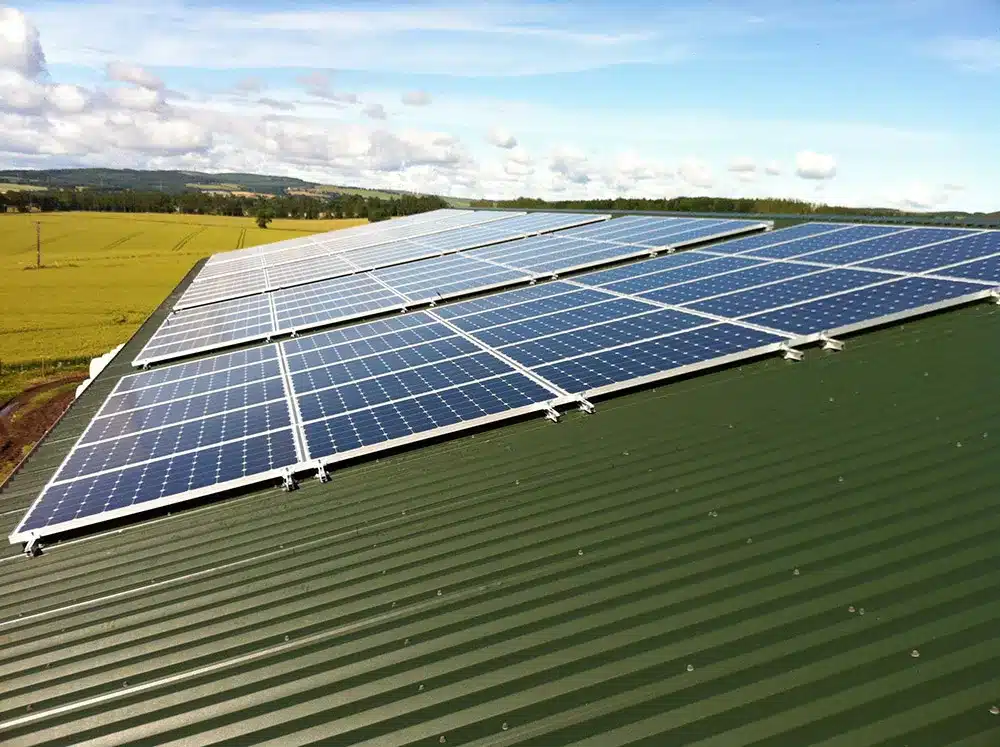
Which UK Farms Have Already Installed Agricultural Solar Panels with Excel Energy?
Seven UK farm projects. Four£ six-figure net profits. A fastest payback of 4.9 years. A highest ROI of 26.5%. And over 180 tonnes of CO₂ are eliminated every year. These are the verified post-installation numbers from Excel Energy’s agricultural solar panel installations.
Farm | Location / Type | System | Headline Outcome |
Cramble Cross Farm | Yorkshire | Poultry | 160kWp (352x DMEGC DM455) + 160kWh (4x TESVOLT TV HV 50) + GridImp controller | £606,885 net profit (25 yrs) | 5yr 8mo payback | 67,075 kg CO₂/yr | 66.2% self-consumption |
Church Farm, Oxhill | Warwickshire | Arable/Mixed | 76.38kWp hybrid (97x LonGi + 80x Canadian 300wp) + 48.4kWh (3x Sigenstor) | 76.3% self-sufficiency | 35,207 kg CO₂/yr | 7yr 9mo payback | 13.62% IRR | £0.0466/kWh LCOE |
Lamberhurst Farm | Kent | Estate / Ground-Mounted | 22x Aiko Stellar 1N+ 645W + 2x SolarEdge 10kWh + Sunfixings Park Tegra mounting | £86,000 net profit (30 yrs) | 7yr 6mo payback | 2.93T CO₂/yr | 15.1 MWh annual yield |
Church Farm, Somerset | Somerset | Dairy | 132kWp DMEGC + SolarEdge inverter + SolarEdge S1000 optimisers + battery | £960,000 net profit (25 yrs) | 4.9yr payback (FITs) | 6.2yr standalone | 27.64T CO₂/yr | 15.93% IRR |
Hardwicke Farm | UK | Cattle | 30.6kWp Trina Solar + Sigenergy 10kWh hybrid inverter + battery | £69,608 net profit (20 yrs) | 6yr 9mo payback | 9,288 kg CO₂/yr | 15.09% IRR |
Stowford Manor Farm | South West | Agriculture | 135kWp REC Solar + 78kWh (SolarEdge + Sigenergy) + K2 Systems mounting | 4.9yr payback | 26.5% ROI | 29.07T CO₂/yr | 131.49 MWh annual output |
Castle Farm | UK | Agriculture | Solar PV + Trina Solar + Sigenergy battery storage | 6yr 9mo payback | 9,170 kg CO₂/yr | 15.09% IRR | 48% solar fraction of annual demand |
Every project above was delivered on budget, commissioned to MCS standards, and is now generating verified electricity with full remote monitoring active.
Read the full technical breakdown behind these agricultural solar panel results. ➤ View All Farm Case Studies | ➤ Read the Cramble Cross Study |
Get your farm-specific figures in under 48 hours. |
Excel Energy holds MCS certification, NAPIT registration, RECC accreditation, TrustMark government endorsement, and ISO 9001, 14001, 45001, and 14068-1 certification. Every accreditation is independently audited. None are self-awarded. Full details and certificate numbers on our accreditations page.
How Do You Know Excel Energy is Qualified for Agricultural Solar Installation?
Industry Accreditations Excel Energy Holds
MCS Certified Installer:
Issued by MCS Certification .
Mandatory for Smart Export Guarantee eligibility. Without MCS, your agricultural solar installation cannot access SEG income.
NAPIT Registered:
Issued by NAPIT . Electrical safety registration.
All farm solar panel installations must be carried out by a registered electrical contractor under Part P and BS 7671.
RECC (Renewable Energy Consumer Code):
Issued by RECC .
Mandatory consumer protection for UK solar installers. Covers pre-sales information, contract terms, installation quality, and complaints resolution.
TrustMark:
Government-endorsed quality scheme issued by TrustMark . Third-party assessed for technical competence, customer service, and trading practices.
ISO 9001:
Issued by BSI / UKAS. Quality Management certification covering project design, installation processes, documentation, and continuous improvement protocols.
ISO 14001:
Issued by BSI / UKAS. Environmental Management System certification. Excel Energy's own operations are managed to a certified environmental standard.
ISO 45001:
issued by BSI / UKAS. Occupational Health and Safety certification. All on-site farm solar panel installation work is conducted under a certified H&S framework.
ISO 14068-1 (Carbon Neutrality):
in progress. Carbon neutrality standard supporting clients' Scope 3 supplier emissions reporting under DEFRA and food retailer requirements.
CHAS:
Contractor health and safety pre-qualification. Required by many estates and large farm businesses for supply chain approval.
Constructionline Gold Member:
Issued by Constructionline. Pre-qualification certification for public and private sector procurement. Excel Energy achieved Gold status (registration 1405795, issued 12 January 2026), meeting the highest tier of supplier assessment for construction and infrastructure projects.
Flexi-Orb:
Additional contractor registration for electrical works on managed commercial and agricultural estates.
Manufacturer Partnership Warranties Behind Every Agricultural Solar System
Product | Manufacturer | Warranty |
DMEGC DM455 Solar Panels | DMEGC Solar | 25-year performance warranty |
Aiko Stellar 1N+ 645W Solar Panels | Aiko Solar | 30-year performance warranty – highest commercially available |
REC Solar Panels | REC Group | 25-year performance warranty |
Trina Solar Panels | Trina Solar | 25-year performance warranty |
GoodWe GW29.9K-ET Hybrid Inverter | GoodWe | 10 years |
SolarEdge SE10000H Inverter | SolarEdge | 20 years |
Sigenergy 10kWh Hybrid Inverter | Sigenergy | 10 years |
TESVOLT TV HV 50 Battery | TESVOLT | 10 years |
Sigenstor EC20BAT | Sigenstor | 10 years |
GridImp Energy Controller | GridImp | 5 years |
Sunfixings Park Tegra Mounting | Sunfixings | 25 years |
Excel Energy Workmanship | Excel Energy | 5 years |
See the full accreditation set and why it matters for your agricultural solar installation.
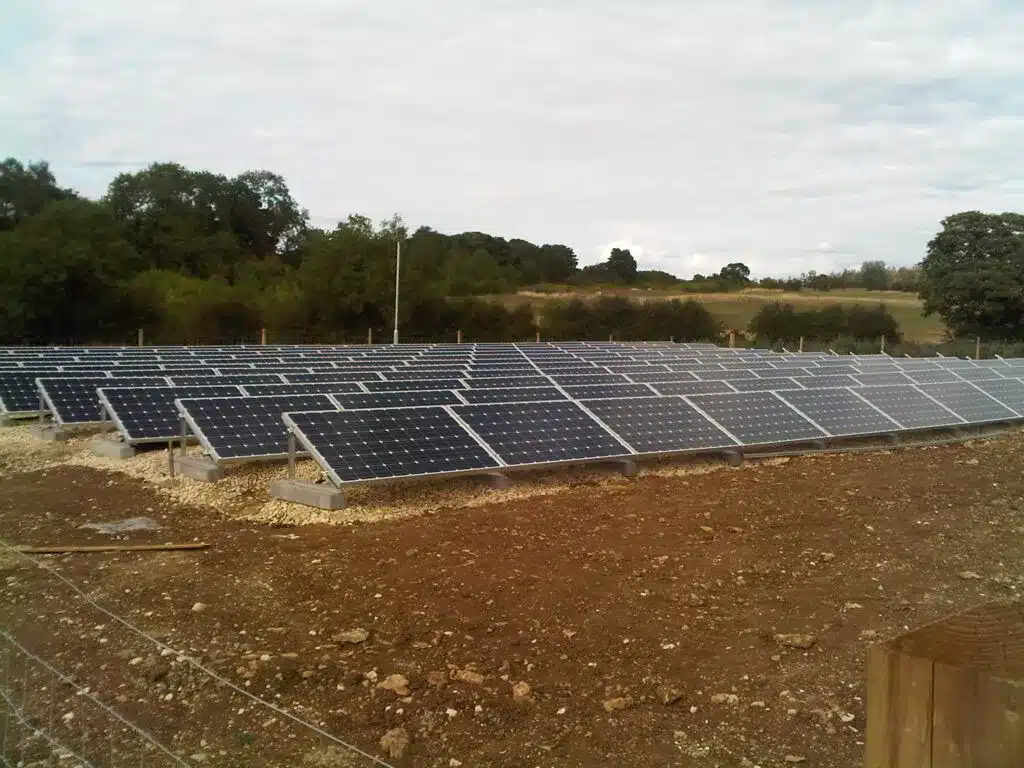
What Does an Agricultural Solar System Actually Include?
An agricultural solar system consists of four components that work together: solar panels, an inverter, a battery storage unit, and an energy management controller. Remove any one and the system either underperforms or fails to deliver the full financial case.
Excel Energy specifies each component to match the farm's exact load profile.
Component | Function | Product Excel Energy Uses | Warranty |
Solar PV Panels | Convert sunlight into DC electricity. Efficiency and wattage determine total annual output. | DMEGC DM455 (22.5% efficiency) | Aiko Stellar 1N+ 645W (23.9% among the highest commercially available) | REC Solar | Trina Solar | LonGi LRS-72 540M | DMEGC: 25 yrs | Aiko: 30 yrs | REC: 25 yrs | Trina: 25 yrs |
Inverter | Converts DC from panels into AC for farm use. Hybrid models integrate battery storage. | GoodWe GW29.9K-ET (three-phase hybrid) | SolarEdge SE10000H | Sigenergy 10kW hybrid | GoodWe: 10 yrs | SolarEdge: 20 yrs | Sigenergy: 10 yrs |
Battery Storage | Stores surplus solar generation for use outside generation hours – overnight, early mornings, peak tariff periods. | TESVOLT TV HV 50 (50kWh per unit) | SolarEdge 10kWh | Sigenstor EC20BAT (16.1kWh per unit) | Sigenergy 8kWh | TESVOLT: 10 yrs | SolarEdge: 10 yrs |
Energy Management Controller | Manages charge and discharge automatically. Optimises self-consumption based on real-time farm demand. | GridImp Energy Controller | 5 years |
Rooftop vs Ground-Mounted Agricultural Solar Panels
Factor | Rooftop Agricultural Solar | Ground-Mounted Farm Solar |
Location | Poultry sheds, dairy barns, grain stores, farm outbuildings | Marginal land, set-aside, unproductive field areas |
System size range | 30kWp to 500kWp | 10kWp to 5MW+ |
Permitted development | Often applies under Class A/B for agricultural buildings | Applies for smaller systems – full planning above 1MW |
Cost per kWp | Lower – uses existing roof structure | Higher – ground works, mounting structures, trenching |
Best for | Operational farms with large roof areas | Estates, landowners, farms with spare acreage |
Primary income | On-site consumption savings | On-site savings plus Smart Export Guarantee revenue |
Excel Energy example | Cramble Cross Farm: 352 panels on south-west poultry shed roofs, 705m² | Lamberhurst Farm, Kent: Park Tegra mounting with trenching and ducting. £86k net profit (30 yrs). |
What is Agrivoltaics?
Agrivoltaics (APV) is the dual use of land for solar energy generation and active agricultural production simultaneously. Elevated arrays allow sheep grazing, low-growing crops, or pollinator habitat beneath the panels. Fraunhofer ISE’s European APV trials show crop yields under optimised arrays at 60-90% of open-field yields, with land equivalent ratios above 1.7. No specific UK permitted development category exists yet; early LPA (Local Planning Authority) engagement is required. Excel Energy assesses agrivoltaic feasibility as part of the free site survey.
Want the right agricultural solar system specified for your site?
➤ Book Your Free Site Survey | ➤ View Ground-Mounted Options
Rooftop, Ground-Mounted or Agrivoltaic: Which Solar Farm Installation Suits Your Land?
The three solar farm installation routes available to UK farms each produce different financial profiles, planning requirements, and income streams. Excel Energy installs all three. Many farms combine rooftop and ground-mounted systems to maximise total site output.
Option 1: Rooftop Agricultural Solar Panels
Fitted to poultry sheds, dairy barns, grain stores, and farm outbuildings. South- or south-west-facing roofs with a 20-35-degree pitch deliver the best annual output across UK latitudes. At Cramble Cross Farm, 352 DMEGC DM455 panels were mounted across south-west-facing poultry shed roofs, covering 705 m² and generating 145,993 kWh annually. Rooftop solar farm installation on agricultural buildings typically qualifies as permitted development, no formal planning application required. See permitted development rights for full conditions.
Option 2: Ground-Mounted Solar Panels on Farm Land
Installed on marginal, unproductive, or set-aside land using aluminum racking on screw-pile or ballasted foundations. Lamberhurst Farm, Kent, a 22-panel Aiko Stellar system on a Sun fixings Park Tegra single-structure mounting with trenching and ducting, generates 15.1 MWh annually and returns £86,000 net profit over 30 years. Larger ground-mounted solar farm installations over 1MW require full planning. For configuration detail, visit our ground-mounted solar page.
Option 3: Agrivoltaics - Dual-Use Solar Farm Installation
Elevated arrays positioned to allow continued agricultural activity beneath or between panels. Livestock grazing, pollinator habitat, or low-growing crop production continues alongside solar generation. The Fraunhofer ISE agrivoltaics programme documents commercial-scale APV across 25+ European sites, with land-equivalent ratios above 1.7.
Excel Energy assesses agrivoltaic feasibility during your free site survey.
Find out which solar farm installation route delivers the strongest return on your land.
How Quickly Do Farm Solar Panels Pay for Themselves?
Excel Energy’s fastest farm solar panel payback is 4.9 years at Stowford Manor Farm, a 135kWp system delivering 26.5% ROI. The longest is 7 years 9 months at Church Farm, Oxhill. Every project sits within the 4.9-to-7.9-year range. These are post-installation monitored results, not projections.
Excel Energy Farm Solar Installations – Verified Results
| Farm | System | Annual Output | Payback | Net Profit | CO₂ Saved/yr | IRR |
| Cramble Cross Farm, Yorks (Poultry) | 160kWp + 160kWh TESVOLT | 145,993 kWh | 5 yrs 8 mo | £606,885 (25 yrs) | 67,075 kg | 20%+ |
| Church Farm, Oxhill, Warks (Arable) | 76.38kWp + 48.4kWh Sigenstor | 77,096 kWh | 7 yrs 9 mo | Substantial long-term savings | 35,207 kg | 13.62% |
| Lamberhurst Farm, Kent (Estate) | 14.19kWh ground-mounted | 15.1 MWh | 7 yrs 6 mo | £86,000 (30 yrs) | 2,930 kg | Market benchmark |
| Church Farm, Somerset (Dairy) | 132kWp + DMEGC + SolarEdge | 143.05 MWh | 4.9 yrs (incl FITs) | 6.2 yrs standalone | £960,000 (25 yrs) | 27,640 kg | 15.93% |
| Hardwicke Farm (Cattle) | 30.6kWp + battery storage | 31,195 kWh | 6 yrs 9 mo | £69,608 (20 yrs) | 9,288 kg | 15.09% |
| Stowford Manor Farm (Agriculture) | 135kWp + 78kWh battery | 131,490 kWh | 4.9 yrs | 26.5% ROI | 29,070 kg | 26.5% ROI |
| Castle Farm (Agriculture) | Solar + battery storage | 31,195 kWh | 6 yrs 9 mo (est.) | Substantial long-term savings | 9,170 kg | 15.09% |
Indicative Cost and Return Ranges for Farm Solar Panels (2025-2026)
| System Size | Installed Cost | Annual Saving | SEG Export Income | Payback |
| 50kWp | £40,000-£50,000 | £7,000-£10,000 | £1,500-£3,000 | 5-7 years |
| 100kWp | £75,000-£100,000 | £14,000-£20,000 | £3,000-£6,000 | 5-6 years |
| 200kWp | £175,000-£225,000 | £28,000-£40,000 | £6,000-£12,000 | 5-7 years |
| 500kWp | £350,000-£450,000 | £70,000-£100,000 | £15,000-£30,000 | 5-6 years |
What Happens to Your Agricultural Solar Energy After Sunset?
Without battery storage, surplus solar generation goes to the grid at export rates that are a fraction of what you pay to import. With three-phase battery storage paired with agricultural solar panels, that surplus is captured and dispatched exactly when farm loads are highest – overnight, early mornings, milking peaks.
Why Agricultural Solar Panels Need Battery Storage More Than Most
How the battery dispatch works in a typical poultry farm scenario
 Solar panels generate from approximately 7 am to 5 pm (summer) or 8 am to 4 pm (winter).
The hybrid inverter converts DC to AC for immediate farm use and simultaneously charges the battery with surplus generation.
The Grid Imp energy controller monitors real-time farm demand and manages charge and discharge cycles automatically.
During overnight shed warm-up or 4 am milking peaks, the battery discharges stored solar energy; no grid draw required.
Any generation beyond battery capacity is exported under the Smart Export Guarantee.
Solar panels generate from approximately 7 am to 5 pm (summer) or 8 am to 4 pm (winter).
The hybrid inverter converts DC to AC for immediate farm use and simultaneously charges the battery with surplus generation.
The Grid Imp energy controller monitors real-time farm demand and manages charge and discharge cycles automatically.
During overnight shed warm-up or 4 am milking peaks, the battery discharges stored solar energy; no grid draw required.
Any generation beyond battery capacity is exported under the Smart Export Guarantee. Battery sizing determines financial performance. An undersized battery wastes midday surplus. An oversized one adds capital cost with diminishing self-consumption returns. Excel Energy profiles your hourly consumption data before specifying capacity. This is why Cramble Cross Farm has 160kWh against 160kWp, while Church Farm Oxhill achieves 76.3% self-sufficiency from only 48.4kWh against 76.38kWp.
Find out what size battery your agricultural solar system needs.
➤ Enquire About Farm Battery Storage | ➤ View Smart Energy Solutions
Is There Government Help to Fund Agricultural Solar Panels on Your Farm?
Yes. The DEFRA Farm Productivity Grant, administered by the Rural Payments Agency, covers agricultural solar PV directly. Minimum grant: £15,000 (25% of a £60,000 project). Maximum: £100,000 per business. Combined maximum across all RPA applications: £500,000. This is not a loan; it is direct grant funding that you do not repay.
Route 1: DEFRA Farm Productivity Grant (Rural Payments Agency)
✅ GOV.UK farming grants - solar PV is an eligible technology under the productivity grant scheme.
✅ Minimum: £15,000 (25% of £60,000 project). Maximum: £100,000 per business.
✅ Remaining project costs covered through commercial loans, overdrafts, or other eligible sources.
✅ Competitive application process. Excel Energy provides supporting documentation from our MCS-certified installation proposals.
Route 2: 100% Capital Allowances (Annual Investment Allowance)
✅ Deduct the full cost of qualifying agricultural solar PV investment from taxable profits in Year 1.
✅ At 25% corporation tax rate: £150,000 system = £37,500 immediate tax reduction.
✅ Sole traders and partnerships claim under AIA via self-assessment. Verify with your agricultural accountant.
✅ Full detail in our commercial finance guide.
Route 3: Solar PPA - Agricultural Solar Panels at Zero Upfront Cost
✅ Excel Energy installs and owns the system. Your farm pays a fixed, below-market rate per kWh generated on site.
✅ Immediate bill savings from day one. No capital outlay. Typical contract: 10-25 years with fixed rate certainty.
✅ Details on ours solar PPA page.
Route 4: Smart Export Guarantee (SEG) Income
✅ All farms with MCS-certified solar installation are eligible for SEG export payments.
✅ Current rates: 5.5p-15p/kWh exported (2025). At Cramble Cross Farm, 49,344 kWh exported annually, at 10p/kWh that is £4,934 additional annual income.
✅ Ofgem SEG guidance, register through your licensed energy supplier.
Route 5: Commercial Solar Finance
✅ Spread costs over 3-10 years through asset finance or a green energy loan. Tax-efficient structures available. See commercial solar financing for current products.
✅ Combine with capital allowances to maximise tax efficiency on financed systems.
Find out which funding routes your agricultural solar project qualifies for.
What Happens Between Your First Call and Your Solar Farm Installation Going Live?
Six stages. All managed in-house. No subcontracted installation teams. No handoffs to third-party project managers. From the first site visit through to ongoing monitoring, every stage is delivered by Excel Energy’s own engineers and certified electricians.
Stage 1: Free Farm Energy Survey and Site Assessment:
Site visit, roof or land evaluation, consumption audit, meter and supply infrastructure check, DNO pre-application assessment. Duration: 1-2 days. Cost: zero.
Stage 2: Financial Modelling and System Proposal:
Site data modelled against PVGIS irradiance data for your exact location. MCS-standard output simulation, payback calculation, 25-year net profit projection, IRR, SEG income estimate, grant eligibility check. Duration: 5-10 business days.
Stage 3: System Design and Engineering:
MCS-compliant design, structural surveys, hardware specification, cable routing, earthing design, reviewed by a qualified electrical engineer. Duration: 2-3 weeks.
Stage 4: Planning and DNO Application:
Permitted development confirmation or full planning submission to the LPA. DNO grid connection application. Excel Energy manages both. Duration: 4-12 weeks depending on route.
Stage 5: Installation and Commissioning:
In-house team. All electrical work to BS 7671. AC and DC infrastructure, panel mounting, inverter commissioning, battery integration, GridImp controller setup, remote monitoring activation. MCS commissioning report issued. Duration: 1-5 days on site.
Stage 6: Monitoring, Maintenance and Support:
5-year online monitoring service included. Annual maintenance packages: panel cleaning, inverter checks, battery health assessments, full BS 7671 electrical testing. 24/7 remote fault detection and diagnosis.
Start the agricultural solar installation process – free survey, no obligation.
➤ Begin Your Farm Survey | ➤ View Solar Maintenance Packages
What Do UK Farm Owners Say About Excel Energy's Farm Solar Panels?
The pattern in client feedback is consistent. Financial projections that match real-world performance. A clean installation with no disruption to live farming operations. A team that understood the agricultural context from the first site visit.
Cramble Cross Farm, Yorkshire – Poultry | 160kWp + 160kWh Battery Storage
“The system has performed exactly as Excel Energy modelled it. Our energy bills are down significantly, the battery manages the overnight load without us doing anything, and the monitoring dashboard gives us the data we need for our sustainability reporting. We would recommend Excel Energy to any farm looking to take control of their energy costs.”
Lamberhurst Farm, Kent – Estate | Ground-Mounted Agricultural Solar System
“We reviewed several providers before choosing Excel Energy. Their financial modelling was the clearest and most detailed we received. The installation was well-organised and completed on time. The remote monitoring works exactly as described.”
Stowford Manor Farm, South West – Agriculture | 135kWp + 78kWh Battery
“From the first survey through to commissioning, the process was managed without fuss. The system is generating well above our initial estimate. Excel Energy delivered exactly what they promised.”
Read verified farm and commercial client testimonials.
➤ Read All Testimonials | ➤ Why Farm Owners Choose Excel Energy
Your Biggest Questions About Agricultural Solar Panels Answered
How many solar panels does a farm need?
Correct sizing depends on annual kWh consumption, roof or land area, and your target self-sufficiency. Cramble Cross Farm (Yorkshire) uses 352 panels at 455W each for a 160kWp system against 145,993 kWh annual demand. A smaller livestock or mixed farm with 40,000-60,000 kWh demand typically fits a 50-80kWp system. Excel Energy models system size against your actual metered data, use our solar calculator for a starting estimate.
How much does it cost to install agricultural solar panels on a UK farm?
2025-2026 installed costs run from £40,000-£50,000 for a 50kWp rooftop system to £350,000-£450,000 for 500kWp. Ground-mounted solar farm installations carry a higher cost per kWp due to civil works and mounting structures. Battery storage adds £15,000-£40,000 depending on capacity. After DEFRA grants (up to £100,000) and 100% first-year capital allowances (reducing tax liability by up to 25% of cost), the net outlay drops substantially. Zero-upfront options are available through our Solar PPA.
Do I need planning permission for solar panels on farm buildings?
For rooftop installations on agricultural buildings, no formal application is required under permitted development rights in most cases. The key conditions: building must not be listed, you are not in an AONB requiring prior approval, and dimensions stay within permitted limits. Ground-mounted agricultural solar panels require full planning over 1MW. Excel Energy confirms planning status during every site survey.
What size battery does a poultry or dairy farm need?
Poultry farms need larger batteries relative to panel output because of overnight ventilation loads. Cramble Cross Farm pairs 160kWp with 160kWh of TESVOLT battery, 1:1 ratio, achieving 66.2% self-consumption. Dairy farms with defined milking peaks can achieve strong results with smaller relative capacity. Church Farm Oxhill uses 48.4kWh against 76.38kWp (0.63:1 ratio) and hits 76.3% self-sufficiency because the milking-peak timing aligns with battery dispatch windows. The right size is calculated from your hourly load profile.
Can I get a grant for agricultural solar panels?
Yes. The DEFRA Farm Productivity Grant provides a minimum of £15,000 and a maximum of £100,000 toward agricultural solar PV equipment and installation. The grant covers 25% of eligible project costs. You fund the remaining 75% through cash, loans, or finance. Combined RPA grant maximum: £500,000 per business across all applications. Applications are competitive. The 100% Capital Allowance applies separately, reducing net cost further through tax efficiency.
What is agrivoltaics and is it right for UK farms?
Agrivoltaics (APV) is the simultaneous use of land for solar generation and agricultural production. Elevated arrays allow sheep grazing, low-growing crops, or pollinator habitat beneath the panels. Fraunhofer ISE European trials show land equivalent ratios above 1.7 at commercial scale. The UK planning framework is still developing, no PD category exists yet. Excel Energy assesses agrivoltaic feasibility during your free site survey.
How long do agricultural solar panels last?
PV panels degrade at 0.4-0.5% per year under IEC 61215 standards. After 25 years, a DMEGC panel still produces 87-88% of original rated output. Aiko panels carry a 30-year performance warranty. Inverter service life: 10-20 years. Battery service life: 10-15 years. Excel Energy’s financial projections account for all replacement cycles within the payback and IRR calculations.
Is agricultural solar worth it for smaller or tenant farms?
For farms with electricity bills above £12,000-£15,000 per year, agricultural solar is financially viable at smaller system sizes. Hardwicke Farm (30.6kWp) achieved a 6yr 9mo payback and £69,608 net profit over 20 years. Tenant farms need landlord consent and sufficient remaining lease term. The DEFRA Farm Productivity Grant is available to tenants as well as owner-occupiers. Excel Energy has direct experience with tenant farm consent and lease structure requirements.
More general questions answered on our FAQ page.
Have a specific question about agricultural solar panels for your farm type?
Ready to Find Out What Farm Solar Panels Could Save Your Farm?
A free farm energy survey from Excel Energy gives you a site-specific agricultural solar system design, PVGIS-verified output simulation, full financial model, and a clear payback figure, before you commit to anything. Every projection is backed by monitored post-installation data from seven verified UK farm installations.
What the Free Survey Includes | Details |
Farm site visit by an Excel Energy engineer | Roof or land assessment, supply infrastructure review, meter data analysis |
Detailed energy consumption audit | Actual metered hourly usage profiled, not generic farm-type estimates |
PVGIS-verified solar output modelling | Irradiance data specific to your OS grid reference, not national averages |
Full financial model | Payback period, IRR, 25-year net profit, SEG income estimate, grant eligibility check |
Battery storage sizing recommendation | Based on your actual load profile, not a rule of thumb |
Funding route recommendations | Grant application support, PPA assessment, capital allowance briefing |
No-obligation outcome | No pressure to proceed. The survey gives you the verified numbers to decide. |
Excel Energy Installs Agricultural Solar Systems Across England and Wales
Seven UK farms have already made the move. Yours could be next.